Where is the fly?
Wide channel view → pickup coordinates
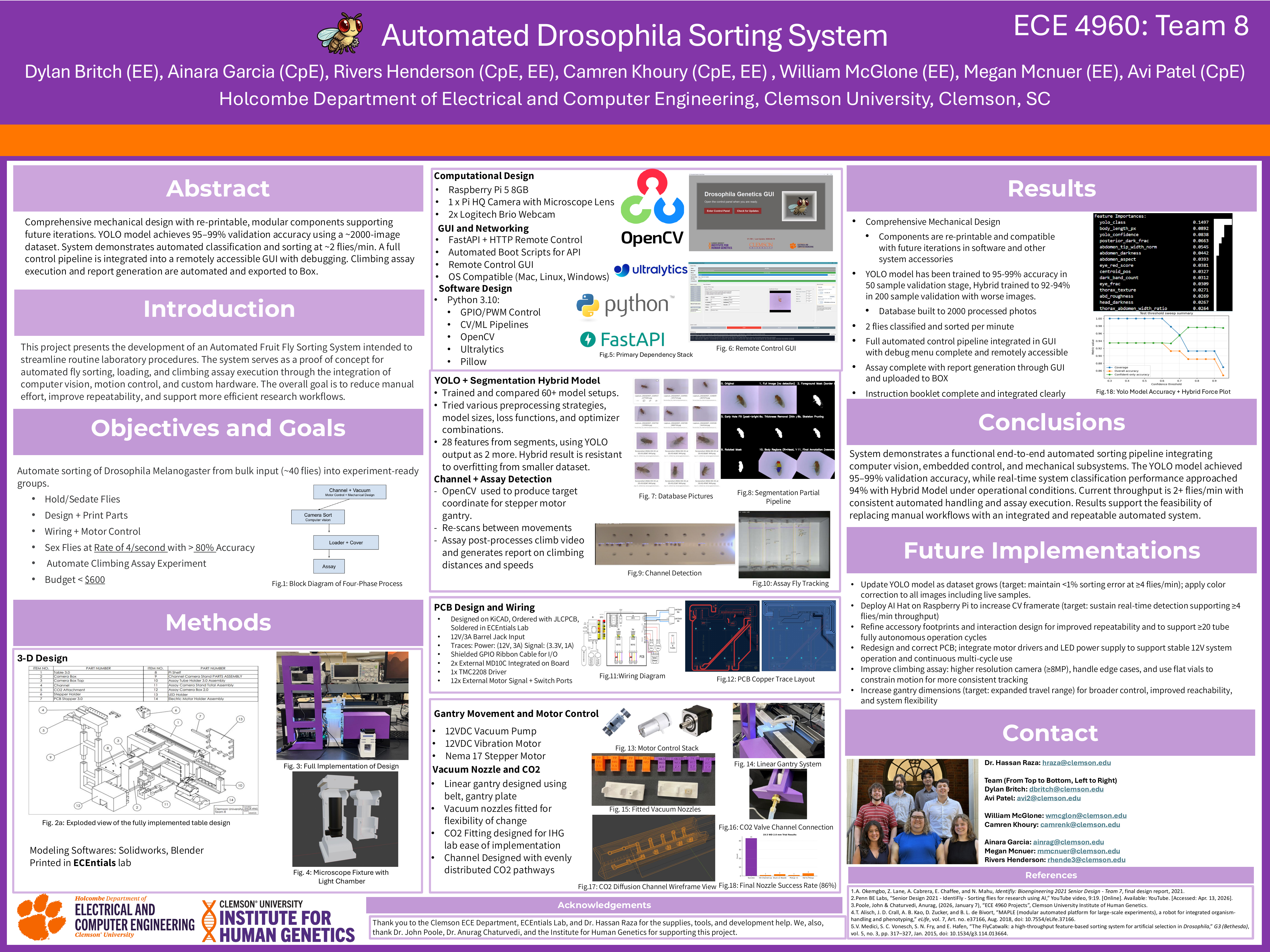
Automated fly handling. Quantitative behavioral assays. Computer vision, custom electronics, and robotics built to reduce repetitive work in genetics research.
1st placePeople’s Choice · Clemson Senior Design Showcase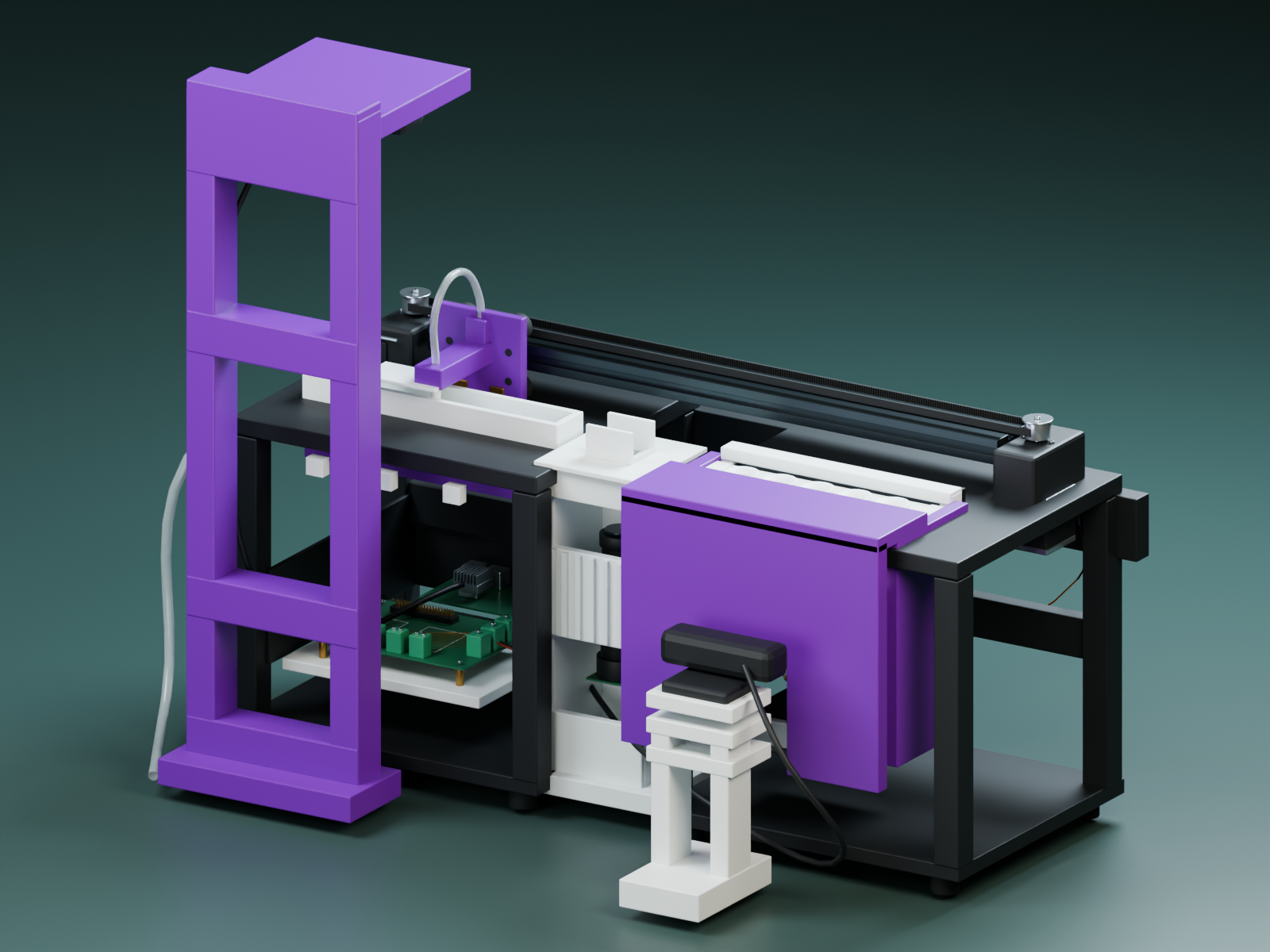
One platform, from fly handling to behavioral data.
Photo-informed reconstructionInspect assemblies + watch the sequence ↗Hover over a discipline to see what we built with it. Every tool connects to a real project artifact.
Modular structures, replaceable channels, and interchangeable vacuum nozzles turn CAD revisions into testable hardware. The interactive Blender reconstruction makes the finished assembly explorable here.
See the design recordGenetic studies depend on preparing the right fly groups and measuring how they behave. Both require repeated, precise work.
Our prototype connects sorting, controlled imaging, and climbing-video analysis. It targets the work between a research question and usable experimental data.
Organize experimental groups with camera-guided handling and physical routing.
Explore the reportA working handling prototype, paired with quantitative video analysis—not just a model prediction. Presentation results ↗
The goal is faster experimental preparation and analysis. The sorting rate is a prototype result, not a measured speedup over a manual workflow.
Start with a fly. End with a result a researcher can inspect. Follow the physical path—and the data it creates.
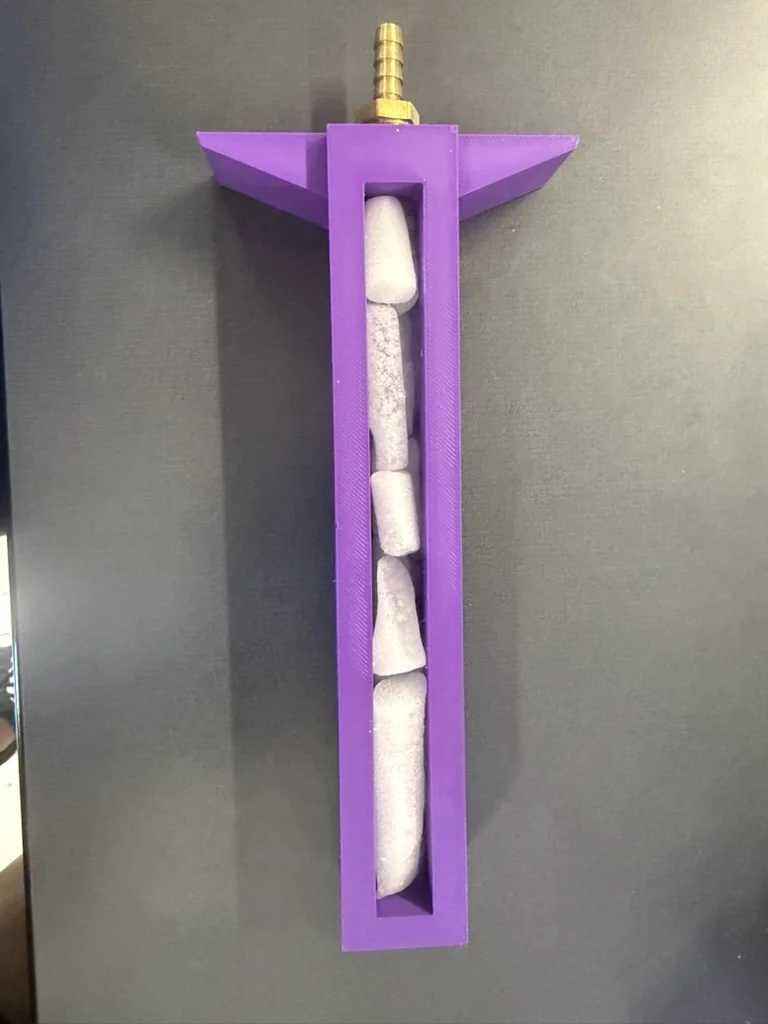
Sedated flies are loaded manually into a printed pickup channel. Channel geometry and CO₂ distribution hardware were iterated to support consistent presentation for camera-guided handling.
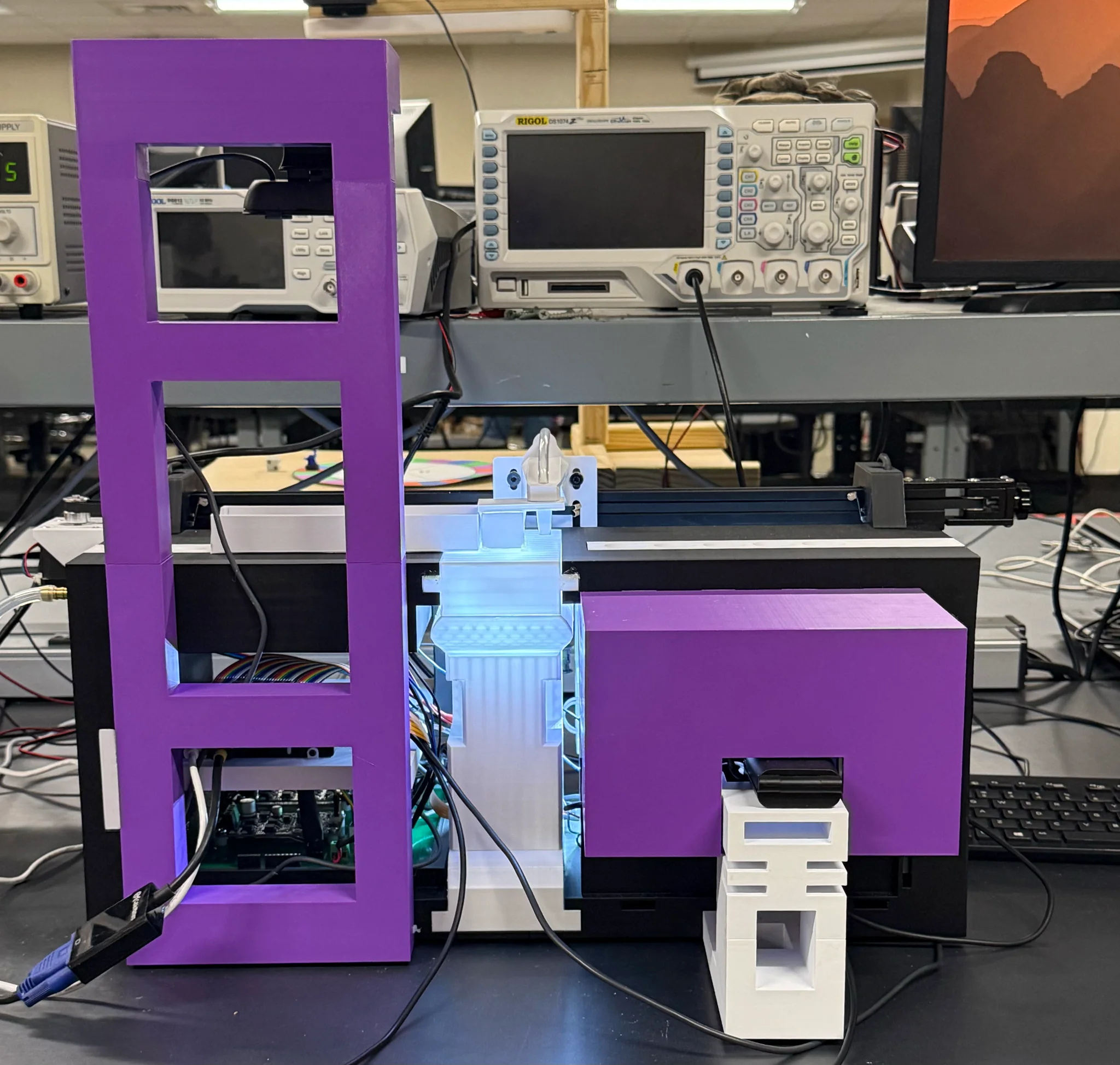
Physical CO₂ manifold and channel assembly
Consistent presentation makes the next image—and the next pickup—more predictable.
Manually loaded, sedated fruit flies
Channel geometry + CO₂-supported handling
Specimens presented within the pickup channel
The walkthrough connects separate subsystem demonstrations, not a continuous run of the same fly. At the assay, individual routing gives way to measuring a prepared vial group.
A wide view to locate. A close-up to classify. A fixed view to measure.
Wide channel view → pickup coordinates
Controlled close-up → classification
Backlit vial view → behavioral analysis
Three short clips, from physical handling to behavioral tracking. Play, scrub, or open full screen.
The belt-driven gantry carries the vacuum head across the channel.
Open clip ↗A closer look at the nozzle and the physical handling interface.
Open clip ↗Recorded assay footage with actual tracking boxes, identifiers, and thresholds.
Open clip ↗Three evaluations, three distinct scopes.
Select a result to inspect what was actually tested.
A focused diagnostic on a test sample: all 19 female images and 26 of 27 male images were classified correctly.
19 / 19 female · 26 / 27 male
Aggregate tally, not test order.
Explore the CAD, control board, vision pipeline, and assay software.
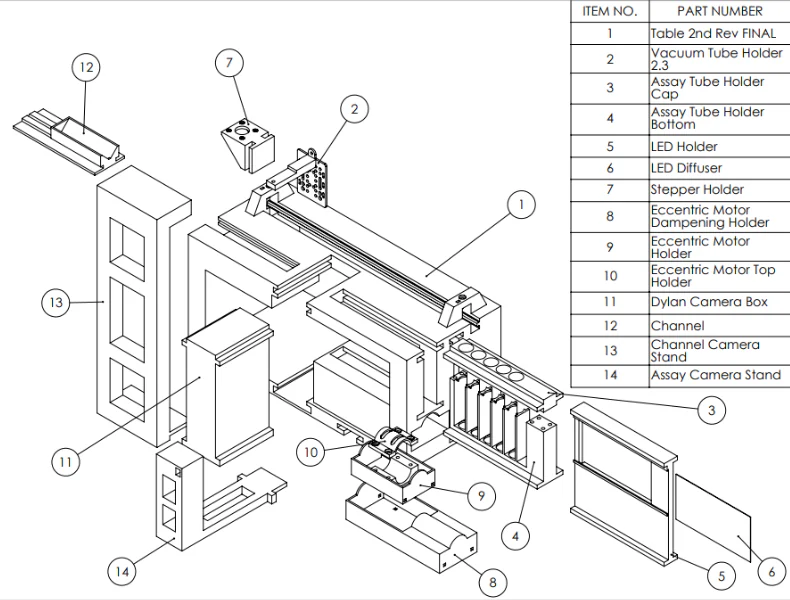
A modular, three-section printed table brings the channel, imaging station, and assay into alignment. Replaceable parts make physical iterations practical.
The hard part was connecting reliable perception to imperfect physical hardware.
Flies could cluster, move, or become difficult to isolate.
ITERATIONIterated channel geometry and CO₂ distribution alongside the pickup interface.
Design record · p. 6 ↗Pickup, release, and lip collisions created different failure modes.
ITERATIONTested nozzle lengths and interfaces; the final nozzle was 19.5 mm long.
Design record · p. 8 ↗Focus, lighting, and background changes affected the image distribution.
ITERATIONRefined the imaging environment and combined learned appearance with segmented morphology.
Design record · p. 15 ↗Frame-by-frame processing competed with acquisition; vibration also coupled through the table.
ITERATIONSeparated recording from offline analysis and investigated the vibration-holder design.
Design record · p. 12 ↗Python / OpenCV / YOLO / Random Forest / Raspberry Pi 5 / KiCad / 3D printing
Original materials from the team’s senior-design project.
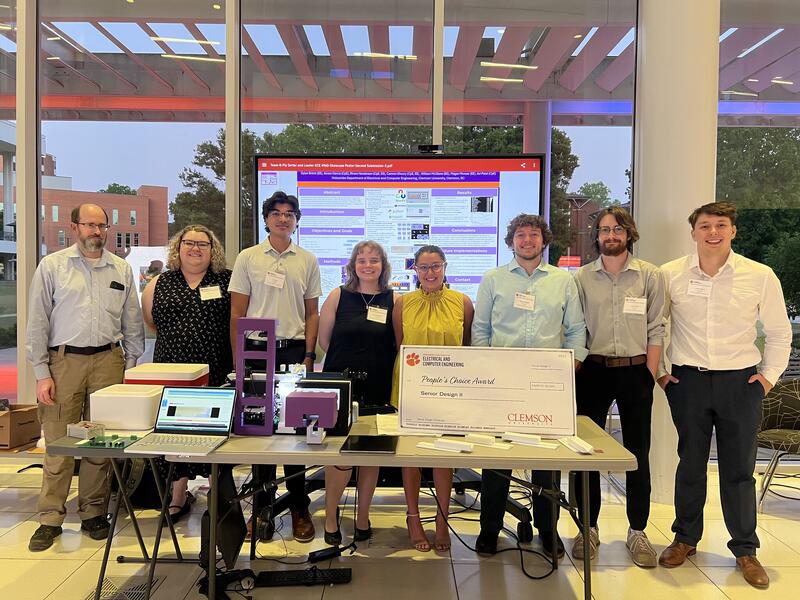 CLEMSON SENIOR DESIGN II / SPRING 2026
Built an autonomous system that identifies, sorts, and evaluates fruit flies for genetics research. Integrated computer vision, embedded controls, and custom hardware to achieve ~97% classification accuracy, earning Clemson’s People’s Choice Award with a cross-functional group of 7 people.
Seven-person senior-design prototype · YOLO diagnostic: 45/46 test images
Clemson University · Institute for Human Genetics sponsor